
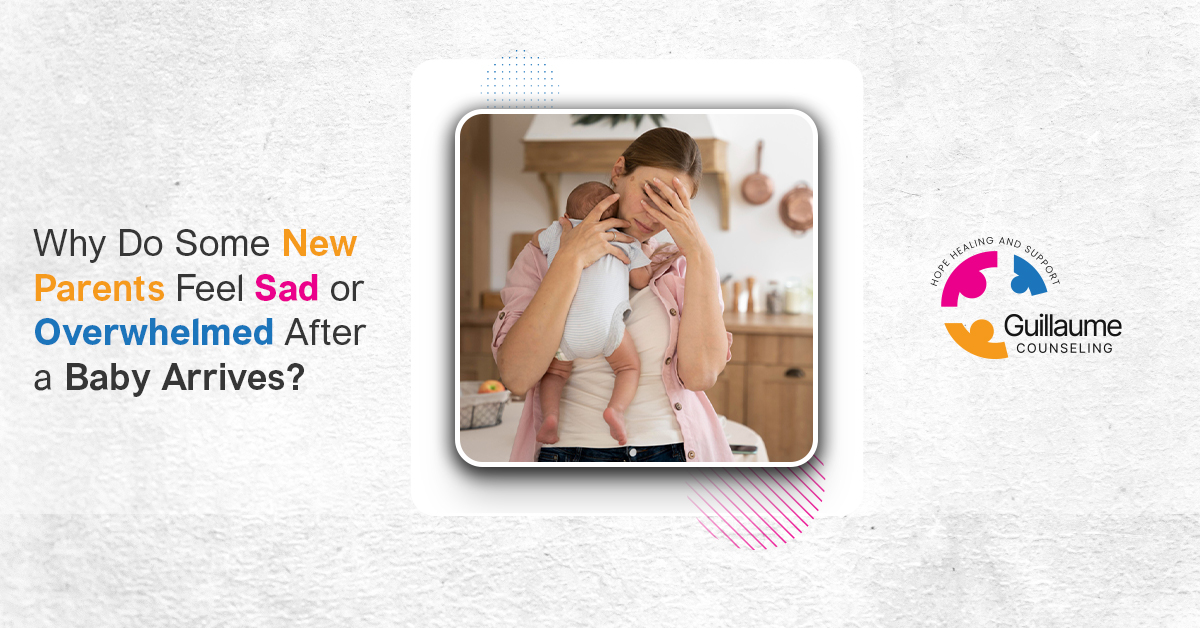
Having a new baby is life-changing and not always the way people expect. Many new parents feel sad, anxious, or overwhelmed, and that’s more common than many realize.
At Guillaume Counseling Services, we provide support for families during pregnancy, postpartum, and beyond. Our goal is to help parents navigate emotional changes that may occur when welcoming a new baby.
Let’s explore why some new parents feel sad or overwhelmed after a baby arrives, and what can help.
Understanding Why Emotions Change After Birth
After giving birth, your body and mind go through significant changes. High hormones during pregnancy fall tediously. There can be a shortage of sleep, and the everyday lifestyle changes radically.
It is natural to be emotional. Feeling sad or overwhelmed doesn’t mean you’re a bad parent. It may be your body and brain adjusting to a big life change.
Some parents also experience depression after breastfeeding. This can happen because their hormones change or they face feeding difficulties. This is a common and treatable experience.
Maternal mental health counseling can be used if emotions feel heavy or if there is difficulty in handling them. Guillaume Counseling Services offers specialized therapy to help new parents explore and manage postpartum challenges.
Baby Blues vs. Postpartum Depression
Many parents experience the baby blues. This can include:
- Crying more than usual
- Feeling moody
- Feeling easily upset
Baby blues usually go away within two weeks.
But sometimes the sadness lasts longer. This may be postpartum depression (PPD). Symptoms of PPD can include:
- Continuous sense of despair or inadequacy
- Loss of interest in previously enjoyed activities
- Find it hard to get along with your infant
In some cases, early support can help parents deal with such problems.
Mental health support at Guillaume Counseling Services aids new dads in handling stress, anxiety, and emotions of being overburdened.
Why Some New Parents Feel Sad or Overwhelmed After a Baby Arrives
New parents may feel depressed or overpowered by several reasons:
- Hormonal Changes
After birth, hormones change quickly. These unbalanced hormones after pregnancy can influence emotions and add to sensations of worry or sorrow.
- Sleep Deprivation
New babies wake up often. When parents do not sleep enough, they may feel tired, stressed. Rest helps emotional well-being. Counselors teach parents ways to relax and reduce stress.
- Adjusting to New Responsibilities
Life may suddenly revolve around feeding, changing and soothing a baby. It’s typical to feel overloaded. Family therapy can help the parents in learning how to relate, divide duties, and stay centered.
- Anxiety About Your Baby
Some parents become anxious about the safety and health of their newborn. Despite being a regular emotion, extreme nervousness is heavy. Support can facilitate parents in securing coping resources to address fear.
Recognizing Signs of Anxiety or Depression
Seek help if you notice these signs:
- Sad most of the time
- Very worried all day
- Angry or easily upset often
- Disconnected from the baby
- Overwhelmed for more than two weeks
A counselor or therapist can support parents. Guillaume Counseling Services provides therapy for pregnancy and postpartum mental health. This includes postpartum mood support. Our goal is to help parents develop skills to manage emotions and stress.
How Guillaume Counseling Services Can Support New Parents
At Guillaume Counseling Services, we recognize that each parent’s journey is unique. Support may include:
- Individual therapy to help parents learn ways to navigate emotional and physical changes
- Couples or family therapy to improve communication and balance responsibilities
- Maternal mental health support for mood changes, stress, and parenting challenges
- Paternal mental health support for fathers adjusting to new responsibilities and supporting their partner
Our services are culturally sensitive and diverse in a variety of languages such as Spanish, Haitian Creole, Hindi, Punjabi, and Urdu.
We collaborate with immigrant families, multiracial families and extended family members to offer knowledge and care.
Practical Tips for Managing Feelings After a Baby Arrives
Here are some small things that may help reduce feelings of sadness or overwhelm
- Let family or friends help with chores or the baby.
- Short rests and pauses can boost a person’s energy and enhance their mood.
- Engaging with fellow parents or joining assistance groups may lighten feelings of solitude.
- Little things, such as a shower, a walk, or a silent period, could assist in boosting mood.
- Dividing tasks with a partner may help lighten the load.
Being depressed or feeling overpowered is not a weakness. The fact that the parents want to be supported is a good move that benefits both the baby and the parents.
Healing Takes Time
Everyone is different. Some parents feel better quickly. Others need more time. What matters most is getting support when needed.
Final Gentle Message
Feeling sad after a baby arrives can be very hard. These feelings are observed in millions of new parents. With small steps, kind support, and help from professionals, parents can feel better.
Guillaume Counseling Services can help parents cope with pregnancy and postpartum care. Book an appointment today for support.
FAQs
When does postpartum anxiety go away naturally?
Mild cases heal in a few months. Moderate and severe cases need treatment to heal completely.
How long do postpartum nightmares last?
They mostly reduce with a decrease in anxiety. With help, they can improve in weeks to months.
Disclaimer: We are Healers. We work with people from all walks of life. We are not politicians, activists, evangelists, or preachers. We are Healers. We strive to hire employees of diverse backgrounds to serve a community who is diverse socially, politically, economically, religiously, racial, ethnically, and culturally.

[…] can also feel tiring, scary, or overwhelming. One moment, you may feel happy. The next moment, you may feel sad or worried. Many feelings are […]
Чимало людей думають, що основна різниця між домашнім мармеладом та магазинним полягає лише в ціні або зовнішньому вигляді, але насправді різниця набагато глибша і стосується насамперед складу та користі для організму. Виділимо ключові пункти:
Склад:
Домашній мармелад готують зі справжнього фруктового пюре, соку та желатину (або агар-агару). У покупному ж часто базою є цукор, патока, загусники та ароматизатори, ідентичні натуральним, замість реальних фруктів.
Смакові якості:
Домашній вирізняється більш ніжним, натуральним присмаком і менш нудотний. Магазинний продукт часто більш насичений і солодкий завдяки хімії.
Користь:
У домашньому зберігаються вітаміни (хоча б частково) та клітковина. У купленому в супермаркеті — самі лише “порожні” калорії та барвники.
Зовнішній вигляд:
Магазинний — ідеально гладкий, яскравий, глянсовий. Домашній може бути трохи мутним, не таким яскравим, швидше розм’якає, проте безпечніший для здоров’я.
Більше подробиць про те, з чого насправді виготовляють магазинні солодощі, дізнаєтеся тут: [url=https://telegra.ph/SHCHo-mi-naspravd%D1%96-imo-poglyad-kr%D1%96z-sklo-domashnogo-marmeladu-02-15]telegra.ph[/url]
levitra
levitra
dapoxetine hydrochloride 60 mg
dapoxetine hydrochloride 60 mg
amoxicillin clavulanate
amoxicillin clavulanate
doxycycline for sinus infection
doxycycline for sinus infection
cytotec vaginally
cytotec vaginally